Research Framework · SNL Dalhousie

Quantum Materials for Sustainable Solutions

Engineering low-dimensional quantum materials to address the world's most pressing challenges in clean energy and food security.

The SNL Research Framework

SNL is dedicated to advancing next-generation quantum materials to address two of the most pressing global challenges: clean energy and food security. Our research framework integrates advanced quantum materials design, understanding of structure–property relationships, and device-level engineering to develop scalable technologies.

At SNL, we engineer low-dimensional quantum materials and systematically design to control composition, size, shape, and interfaces, enabling precise tuning of optical, structural, and carrier dynamics. By establishing strong structure–property relationships, we optimize light absorption, charge separation, and transport processes — bridging fundamental materials design and product-oriented device development to ensure real-world applicability.
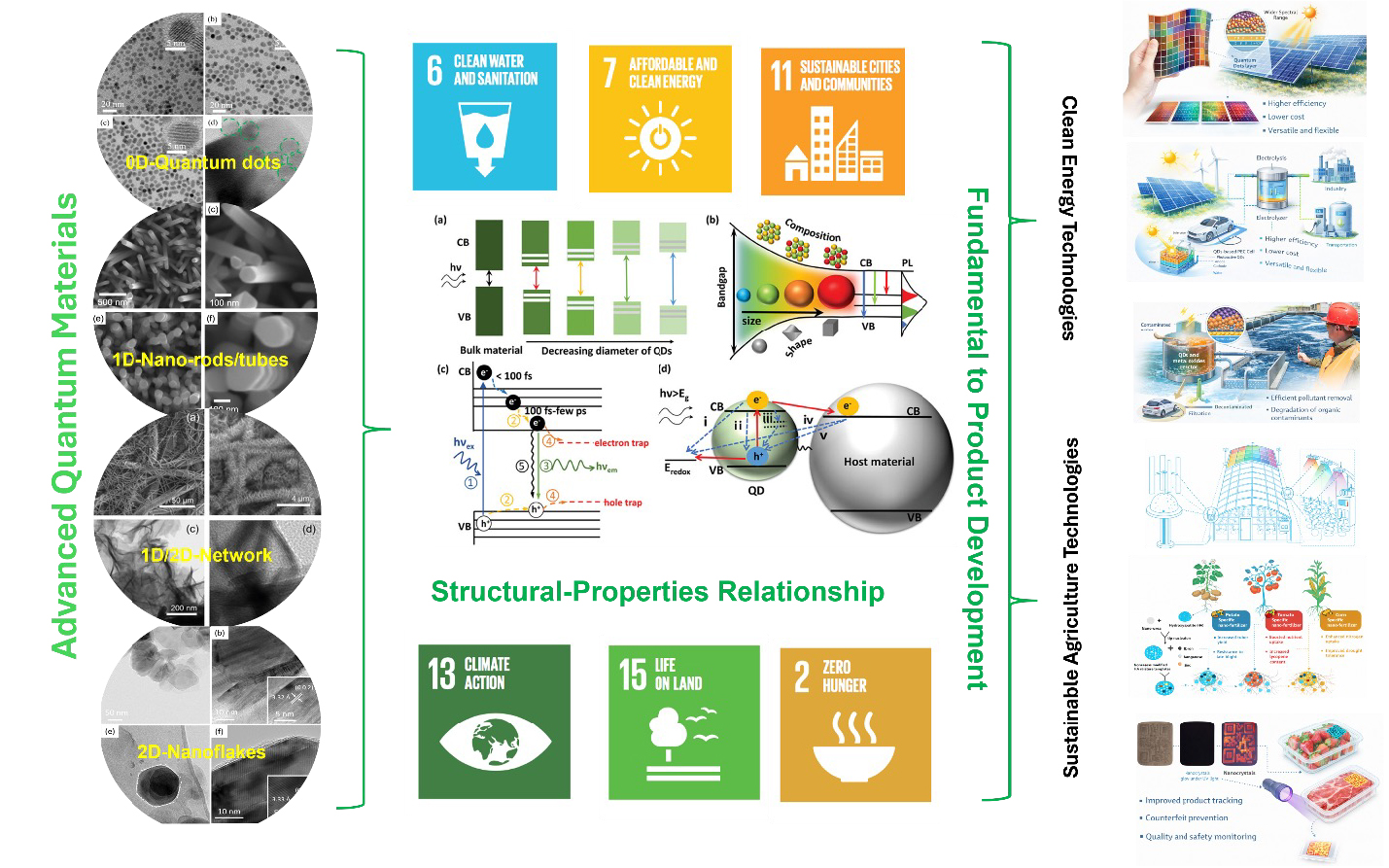
SNL Research Framework — Advanced Quantum Materials, Structure–Property Relationships, Fundamental to Product Development
Approach I
Advanced quantum materials design with controlled composition, size, shape, and interfaces
Approach II
Structure–property relationship optimization for light absorption and charge dynamics
Approach III
Interface engineering, defect control, and scalable synthesis for device integration
Vision
Integrated climate-resilient energy–food–water solutions for long-term societal impact
I
Theme I · Clean Energy

Clean Energy Technologies

Developing high-performing and cost-effective clean energy technologies to meet future energy needs while mitigating climate change. Smart nanoengineered materials offer unique size-dependent photophysical and chemical properties, enabling breakthroughs across photovoltaics, green fuel generation, and environmental remediation.

e⁻ hν → e⁻ + h⁺ → V
Theme I · Sub-theme i

High-Efficiency Third-Generation Photovoltaics

Quantum DotsSolar CellsInterface Engineering
Advancing high-efficiency PV technologies through nanoengineering of colloidal quantum dots and hybrid nanostructures. Core/shell interface engineering, band alignment optimization, and surface defect passivation suppress non-radiative recombination and enhance charge carrier dynamics.
Our research advances high-efficiency third-generation photovoltaic technologies through nanoengineering of colloidal quantum dots, low-dimensional, and hybrid nanostructures. By leveraging strategies such as core/shell interface engineering, band alignment optimization, and surface defect passivation, we suppress non-radiative recombination and enhance charge carrier dynamics.

We have demonstrated that incorporating controlled amounts of carbonaceous nanostructures into mesoporous TiO₂ photoanodes significantly improves power conversion efficiency and long-term stability — not through percolation effects, but by facilitating improved electron injection at the photoanode/front-contact interface. Further innovations include spray-assisted blocking layers, graphene as a low-cost transparent conducting alternative to FTO/ITO, and scalable single-step synthesis of Cu₂S cathodes with superior catalytic activity compared to noble metals.
PEC H₂ O₂ also NH₃ 2H₂O → 2H₂ + O₂
Theme I · Sub-theme ii

Sustainable Fuel & Chemical Generation (H₂, NH₃)

Green HydrogenPhotoelectrochemistryCircular Agriculture
Developing scalable technologies for clean fuel production via high-performance photoelectrodes and tandem PEC–PV systems enabling bias-free, solar-driven H₂ generation. We also pioneer a closed-loop N₂O capture pathway converting agricultural waste into locally produced NH₃ fertilizer.
We develop scalable, low-cost technologies for clean fuel and chemical production using advanced quantum materials and interfacial nanoengineering, aligned with Canada's Hydrogen Strategy. High-performance photoelectrodes and tandem photoelectrochemical–photovoltaic systems enable bias-free, solar-driven green hydrogen (H₂) generation through optimized charge separation and transport.

Our work on colloidal core/shell nanocrystals demonstrates precise control over electron–hole dynamics for enhanced solar energy conversion. Extending beyond hydrogen, we have pioneered a closed-loop nitrogen approach that captures N₂O emissions from agricultural waste streams and converts them into locally produced ammonia (NH₃) fertilizer, offering a sustainable pathway for circular agriculture. Additional innovations include radiation-resilient nanomaterials and nanoengineered solid-state electrolytes based on functionalized h-BN nanosheets.
dye clean ~99.9% pollutant removal
Theme I · Sub-theme iii

Advanced Environmental Remediation & Water Purification

PhotocatalysisPollutant DegradationNanohybrids
Eco-friendly QD-based nanohybrid photocatalysts enable highly efficient solar-driven degradation of toxic organic pollutants and industrial dyes — achieving up to ~99.9% removal with improved stability and recyclability.
Our team advances sustainable water treatment technologies by designing eco-friendly quantum dot–based nanohybrid photocatalysts. These multifunctional QD-nanostructured systems enable highly efficient degradation of toxic organic pollutants and industrial dyes under solar-driven conditions.

By engineering interfacial charge transfer, enhancing light absorption, and incorporating external stimuli such as magnetic or electric fields, these systems achieve complete pollutant removal (up to ~99.9%) with improved stability and recyclability. We are advancing these technologies by coupling pollutant degradation with clean energy generation (e.g., hydrogen production), offering scalable, low-cost, and environmentally benign solutions for next-generation water purification and environmental remediation.
II
Theme II · Agriculture

Sustainable Agriculture Technologies

The accelerating impacts of climate change and rising global food demand have created an urgent need for transformative agricultural technologies. In Canada, the loss of approximately three farms per day over the past two decades underscores the need for innovation. Our research explores how light interacts with advanced quantum materials and electrostatic energy to develop next-generation smart greenhouse technologies and nanoengineered fertilizers.

PAR spectrum control + nanogenerators
Theme II · Sub-theme i

Smart Greenhouse Coupled with Nanogenerators & Spectrum-Controlled Roof

Controlled EnvironmentNanogeneratorsPAR Spectrum
Eco-friendly quantum materials integrated into greenhouse roofs selectively tune transmitted light within the photosynthetically active radiation (PAR) region. Coupled with nanogenerators and energy-harvesting architectures, these systems reduce operational costs and enable year-round cultivation.
We develop next-generation controlled-environment agriculture technologies based on eco-friendly quantum materials engineered into greenhouse roofs that selectively tune the quality and quantity of transmitted light within the photosynthetically active radiation (PAR) region. This enables spectrum-controlled greenhouses to boost crop production while maintaining sustainability.

By coupling these systems with nanogenerators and energy-harvesting architectures, we aim to significantly reduce operational energy costs, enhance crop productivity, and enable sustainable, year-round cultivation. This has strong potential to reduce greenhouse carbon footprints, support off-grid and remote farming communities, and contribute to Canada's net-zero and food security goals.
marine/agri waste NP controlled nutrient release
Theme II · Sub-theme ii

Crop-Specific Nano-Engineered Fertilizers

Nano-FertilizersCircular EconomyNutrient Delivery
Next-generation crop-specific nanofertilizers valorize agricultural and marine waste into high-performance nutrient-delivery systems with controlled, targeted release — improving nutrient-use efficiency while reducing environmental losses and supporting a circular economy.
We develop next-generation, crop-specific nanoengineered fertilizers using a novel template-assisted approach that valorizes agricultural and marine waste into high-performance nutrient-delivery systems. These nano-fertilizers provide controlled and targeted nutrient release, significantly improving nutrient-use efficiency while reducing fertilizer input and environmental losses.

Our approach promotes a circular economy by converting waste into value-added products, while enhancing soil health, farmer profitability, and long-term food security. The promising outcomes have attracted growing interest from industrial partners and non-profit organizations, opening new avenues for scalable and impactful nanofertilizer technologies.
UV luminescent QD codes for authentication
Theme II · Sub-theme iii

Anti-Counterfeiting & Smart Food Packaging Technologies

Luminescent QDsFood SafetySupply Chain
Luminescent nanomaterials from agricultural and marine waste exhibit strong, tunable fluorescence under UV excitation — enabling invisible, high-resolution QR codes embedded directly into packaging for authentication, counterfeit prevention, and real-time supply chain tracking.
We develop advanced anti-counterfeiting and smart food packaging technologies using luminescent nanomaterials derived from agricultural and marine waste. These materials exhibit strong, tunable fluorescence under UV or specific light excitation, enabling the creation of invisible, high-resolution codes (e.g., QR/barcodes) directly embedded into packaging systems.

Such nano-enabled security features provide robust solutions for product authentication, counterfeit prevention, and real-time tracking across the supply chain. In addition, these technologies support food quality and safety monitoring by enabling rapid, non-destructive inspection, enhancing consumer trust, reducing economic losses, and contributing to safer and more transparent food systems.

Techniques & Characterization Tools

Electron Microscopy

TEM/SEM for nanoscale imaging and structural analysis

X-Ray Diffraction

Crystal structure and phase identification of nanomaterials

UV-Vis Spectroscopy

Optical bandgap and absorption characterization

Electrochemical Analysis

Cyclic voltammetry and impedance spectroscopy

Temperature (°C)

Thermal Analysis

TGA/DSC for decomposition and phase transition studies

Photoluminescence Spectroscopy

Fluorescence and quantum yield characterization

Research Funding · Dalhousie (2022 – Present)

Grants & Active Projects

Dr. Selopal has secured significant research funding since joining Dalhousie, spanning clean energy, sustainable agriculture, and precision nanotechnology — through NSERC, CFI, MITACS, and government partnerships.

20
Active & Recent Grants
across federal & provincial agencies

QD-Enhanced Polymeric Films for Sustainable Crop Production

PI
Invest Nova Scotia & Stokdijk Greenhouses Ltd.

Infrastructure for Sustainable Nanoengineering Lab

PI
Canada Foundation for Innovation (CFI)

Advanced Nanoengineering for Efficient Clean Sustainable Energy Technologies

PI
NSERC Discovery Grant

Tandem Photoelectrochemical–Photovoltaic System for Bias-Free Green Hydrogen Production

PI
NSERC–Alliance Catalyst

Self-Powered Photoelectrochemical System for Green Hydrogen Production from Seawater

Supervisor/PI
Nova Scotia Graduate Scholarship & Dalhousie Research Excellence Scholarship

Self-Powered Greenhouse System Design to Promote Sustainable Agriculture

PI
Global Research Seed Fund, Dalhousie University

QD-Assisted Spectrum Controlled Intelligent Greenhouse: A Sustainable Solution for Food Security

PI
Nova Scotia Dept. of Agriculture – SCAP

Design of QD-Based Spectrum-Controlled Greenhouse Tarp to Enhance Crop Yield

Supervisor/PI
BMO Financial Group Graduate Scholarship

Optimization of Nano-fertilizer to Boost Potato Production and Environmental Sustainability

PI
Sustainable Canadian Agricultural Partnership (Canada)

Marine/Agricultural Waste–Assisted Cost-Effective Nanofertilizer for Potato Production

Supervisor/PI
McCain Foundation Postdoctoral Fellowships in Sustainable Agriculture

Optimization of Marine Waste-Derived Hybrid Nano-fertilizers for Enhanced Nutrient Use Efficiency

Supervisor/PI
Nova Scotia Graduate Scholarship

Exploring Crop Physiological Changes Induced by Sustainable Electric Field for Food Security

Supervisor/PI
Nova Scotia Graduate Scholarship

Self-Powered Triboelectric-Piezoelectric Nanogenerators for Sustainable Agriculture

Supervisor/PI
Nova Scotia Graduate Scholarship

Harnessing Quantum Dots for Efficient Water Splitting for Green Hydrogen Production

Supervisor/PI
Killam Predoctoral Scholarship Level 1

Magnetic/Ferroelectric Controlled Hybrid Photocatalysts for Environmental Remediation

Supervisor/PI
MITACS–Globalink Scholarship

Investigating Sugar Kelp as an Environment-Friendly Biofertilizer for Sustainable Potato Production

Co-PI
MITACS–Accelerate & Food Island Partnership

AI-Driven Zoning Solutions for PEI Net-Zero and Infrastructure Resilience

Co-PI
Climate Challenge Fund, PEI – Environment Energy and Climate Action

Development of Transformative Precision Agriculture Technologies for Food Security

Co-PI
NSERC-SSHRC Sustainable Agriculture – University of PEI

Optimization of Self-Powered Greenhouse System Design (Phase II)

PI
VPRI-GRSF, Dalhousie University

Nanoengineering for Clean Sustainable Energy Conversion Technologies

PI
Dalhousie University – Launch Fund